
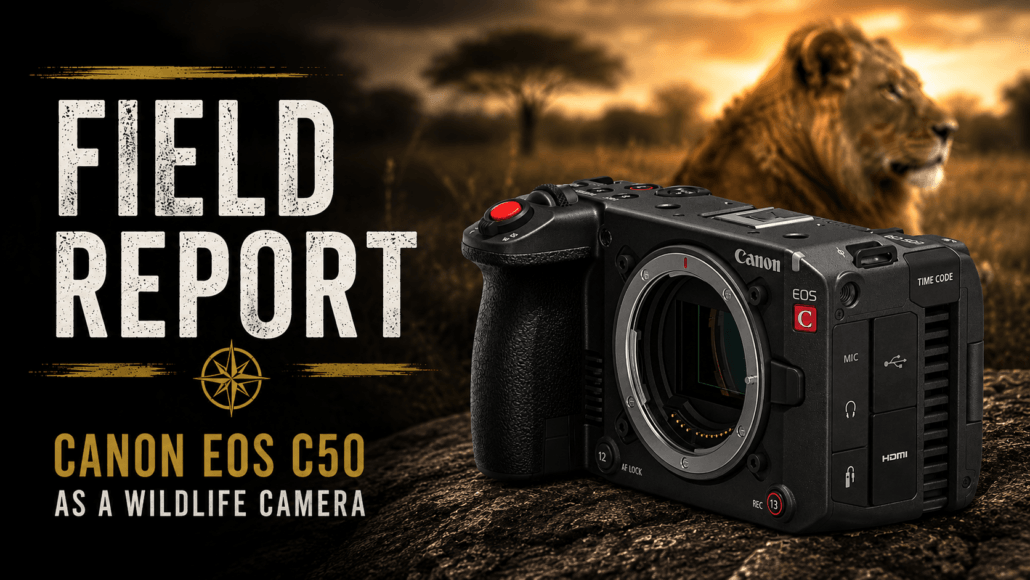
Field Tested: The Canon EOS C50 as a Wildlife Stills Camera – Part 1
A Wildlife Photographer’s Perspective on the Canon EOS C50
By Armand Grobler
Introduction
When Canon announced the EOS C50, most photographers immediately classified it as a cinema camera. They weren’t wrong. Built within Canon’s renowned Cinema EOS range, the C50 was designed primarily for filmmakers, documentary producers and commercial storytellers. Wildlife photographers, however, largely overlooked it, assuming it was simply another video camera with the ability to capture the occasional still image.
I wasn’t convinced they should.
Over the past few years, the line between professional photography and filmmaking has become increasingly blurred. Clients no longer ask solely for breathtaking wildlife photographs; they also expect cinematic footage, social media content and documentary-quality storytelling. Carrying multiple camera systems into the African bush is becoming increasingly impractical, making the search for a genuine hybrid camera more relevant than ever before.
During June, I decided to put Canon’s latest Cinema EOS body to the test on our six-night Sabi Sand Big Cat Photo Safari. Rather than evaluating its impressive filmmaking credentials, I wanted to answer a question that surprisingly few people had asked: “Can the Canon EOS C50 genuinely perform as a professional wildlife still-photography camera?”
Over six days, the camera photographed countless spontaneous wildlife encounters that demanded fast autofocus, reliable burst shooting and exceptional image quality. With a focus on the big cats – we had many fantastic opportunities to test the C50 system. It experienced freezing mornings, dusty roads, harsh sunlight, rapidly changing light conditions and some of the most demanding autofocus situations Africa has to offer (particularly with leopards!).
This is not a laboratory review… It is a field report.
What is the Canon EOS C50?
The Canon EOS C50 is the latest addition to Canon’s highly respected Cinema EOS line-up and represents one of the smallest and lightest full-frame Cinema EOS cameras the company has ever produced. Designed primarily for agile filmmakers, documentary producers, hybrid content creators and commercial storytellers, the C50 delivers professional cinema capabilities in an incredibly compact body.
Unlike Canon’s EOS R-series cameras, the C50 was never designed to replace a dedicated stills camera. It is, first and foremost, a cinema camera designed for videographers. However, beneath its filmmaking pedigree lies a remarkably capable photographic tool – one that surprised me far more than I expected.
While its primary purpose is motion picture production, Canon has quietly included many of the features wildlife photographers value most: a high-resolution full-frame sensor, rapid 40 frames-per-second burst shooting, advanced subject detection autofocus, RAW still photography and pre-capture functionality.
On paper, it begins to look less like a cinema camera with photographic capability and more like a genuinely capable hybrid system.
The question, however, remained whether those specifications would translate into real-world performance in one of Africa’s most demanding photographic environments.
Canon EOS C50 Specifications
Before discussing its performance, it is worth understanding exactly what the Canon EOS C50 offers.
Canon EOS C50 Sensor Specs:
- Approx. 32.3 MP effective full-frame CMOS sensor
- Full-frame image capture
- Super 35 crop mode
- Super 16 crop mode
For wildlife photographers, this provides an excellent balance between image resolution, low-light performance and manageable file sizes. There is sufficient resolution for substantial cropping while still maintaining outstanding image quality suitable for large-format printing and commercial publication.
Video Recording
The camera’s cinema heritage immediately becomes apparent.
The Canon EOS C50 is capable of recording:
- 7K Open Gate Cinema RAW Light (12-bit) up to 60 fps
- 4K up to 120 fps
- 2K up to 180 fps
Open Gate recording is particularly valuable for filmmakers, allowing footage to be cropped into multiple aspect ratios for YouTube, Instagram, television and cinematic productions without sacrificing image quality.
Recording Formats
The C50 supports:
- Cinema RAW Light (12-bit)
- XF-AVC
- XF-HEVC
- MP4
This flexibility allows filmmakers to prioritise either maximum image quality or an efficient editing workflow depending on the production requirements.
Color Profiles
Professional colour grading remains one of Canon’s greatest strengths.
The camera includes:
- Canon Log 2
- Canon Log 3
- HDR (PQ)
- BT.709
- Wide Dynamic Range
Canon Log 2 delivers more than 15 stops of dynamic range in full-frame recording and up to 16 stops in Super 35 mode, providing exceptional flexibility during post-production and colour grading.
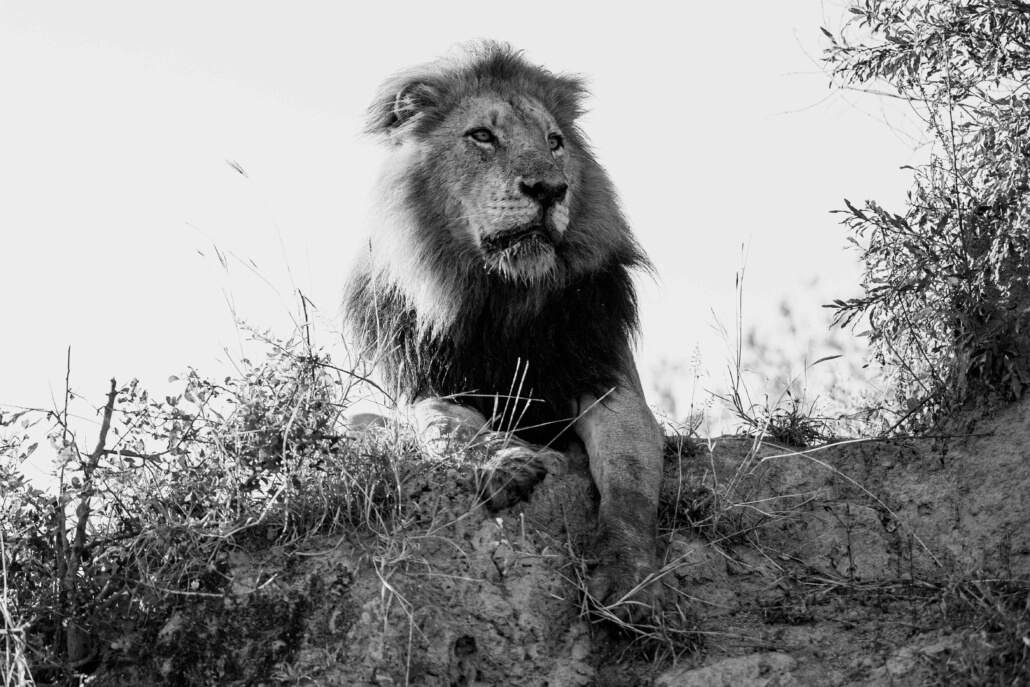
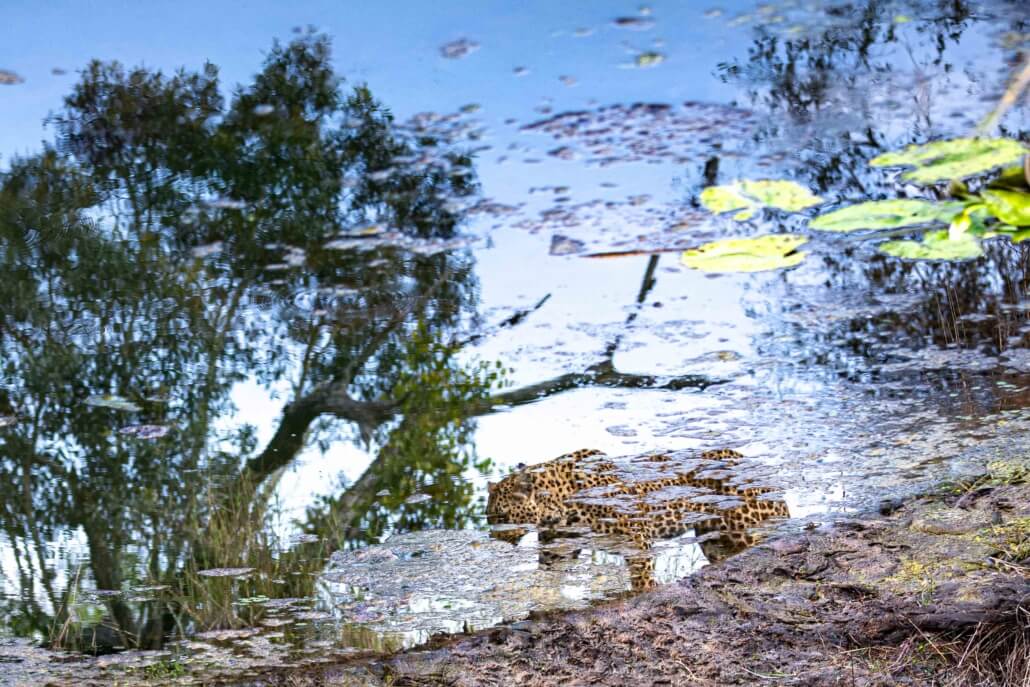
Image Processor
Powering the camera is Canon’s latest DIGIC DV7 processor, enabling rapid autofocus calculations, sophisticated subject recognition and burst photography at up to 40 frames per second.
Autofocus
Canon’s renowned Dual Pixel CMOS AF II remains one of the industry’s benchmark autofocus systems.
Subject detection includes:
- Animals
- Birds
- People
- Vehicles
Combined with Eye Detection AF and Face Detection AF, the system proved exceptionally capable throughout our time in the Sabi Sand – a topic I will discuss in far greater detail later in this review.
Burst Photography
Although marketed primarily as a cinema camera, the EOS C50 is capable of:
- Up to 40 frames per second RAW images
- Electronic shutter operation (no mechanical)
- RAW, JPEG and HEIF image capture
- 20-frame Pre-Continuous Shooting in RAW
For wildlife photographers, pre-capture is one of the camera’s most exciting features. Rather than relying solely on reaction time, the camera continuously buffers images while the shutter button is half-pressed, recording the moments immediately before the shutter is fully depressed. It is a remarkably useful feature when photographing unpredictable wildlife behaviour such as birds taking flight, leopards launching into a chase or lions suddenly roaring.
Dual Base ISO
The EOS C50 also incorporates Dual Base ISO technology (ISO 800 and ISO 6400), allowing exceptionally clean image quality in challenging low-light conditions—particularly useful for wildlife photographers working before sunrise and after sunset.
Active Cooling
Unlike most mirrorless cameras, the C50 features an active internal cooling system. For still photographers this may seem insignificant. For filmmakers working in the African bush, however, it is nothing short of revolutionary – a feature that would later prove itself beyond all expectation during a cheetah hunt in the Kalahari Desert.
First Impressions
Specification sheets rarely tell the full story. Every modern professional camera appears exceptional on paper. Autofocus is faster. Resolution is higher. Dynamic range continues to improve. Marketing departments have become exceptionally good at convincing photographers that the newest camera is also the greatest camera ever produced.
The African bush has a way of exposing reality. It doesn’t care about specifications or advertising slogans. It simply reveals whether a camera can perform when the light disappears, when dust settles on every surface, when a leopard emerges from dense vegetation before sunrise, or when the moment you’ve waited hours for lasts less than a single second.
By the end of six days in the Sabi Sand, I realised I wasn’t simply testing a cinema camera. I was testing whether Canon had quietly created one of the most capable hybrid wildlife cameras currently available and, to my surprise, the answer wasn’t nearly as straightforward as I had expected.
Who Was the Camera Built For?
The Canon EOS C50 is a camera designed for content creators who rely on both still photography and professional video within their workflow. However, it is important to understand the philosophy behind the camera. The C50 is, first and foremost, a professional cinema camera with exceptional still-photography capabilities – not the other way around.
In an era where visual storytelling is increasingly dominated by motion pictures, Canon has recognised the changing demands of the industry. Today’s wildlife photographers are no longer expected to deliver only stunning photographs; they are increasingly required to produce cinematic footage, social media content, documentaries and commercial productions from a single assignment.
The EOS C50 bridges that gap beautifully.
It combines the imaging performance found in Canon’s latest mirrorless cameras, including the EOS R6 Mark III, with the professional video features expected from Canon’s Cinema EOS system. The result is a remarkably versatile camera capable of producing professional-quality stills while simultaneously meeting the demands of modern filmmaking.
Despite being designed with videographers in mind, I wanted to put its still photography capabilities under the microscope and discover whether this cinema camera could genuinely compete with Canon’s dedicated photographic bodies in the demanding environment of African wildlife photography.
Image Quality in Extreme Conditions
Image quality is ultimately what separates a good camera from a great one. Specifications may impress on paper, but they mean very little if the files don’t hold together during post-processing or if the camera struggles in difficult lighting conditions. Wildlife photography presents some of the most demanding scenarios imaginable, with constantly changing light, deep shadows, bright highlights and fast-moving subjects that rarely wait for perfect conditions.
Throughout six days in the Sabi Sand, I intentionally pushed the Canon EOS C50 into situations where weaknesses would quickly become apparent. To my surprise, very few did.
Canon Color Science
If there is one area where Canon has consistently excelled over the years, it is colour science. This is one of those characteristics that cannot easily be measured on a specification sheet, yet it becomes immediately obvious once you begin editing your images.
Wildlife photography presents an incredibly challenging color palette. Warm sunrise light, deep green vegetation, golden grasslands, sapphire skies and rich earth tones all exist within the same frame. It is very easy for colors to become oversaturated or unrealistic during processing yet, the Canon EOS C50 handled these scenes beautifully.
Colors appeared natural straight out of camera, with rich yet believable saturation that required very little adjustment during editing. I personally shoot with a custom White Balance (Kelvin) and adjust it according to the requirements from each individual scene. Greens remained realistic, sunsets retained their warmth without becoming excessively orange, and the subtle color variations within animal fur were beautifully preserved.
For photographers who spend hours processing RAW files, this becomes an enormous advantage – rather than correcting inaccurate colors, you are free to focus on enhancing the mood and atmosphere of the image.
Noise Performance
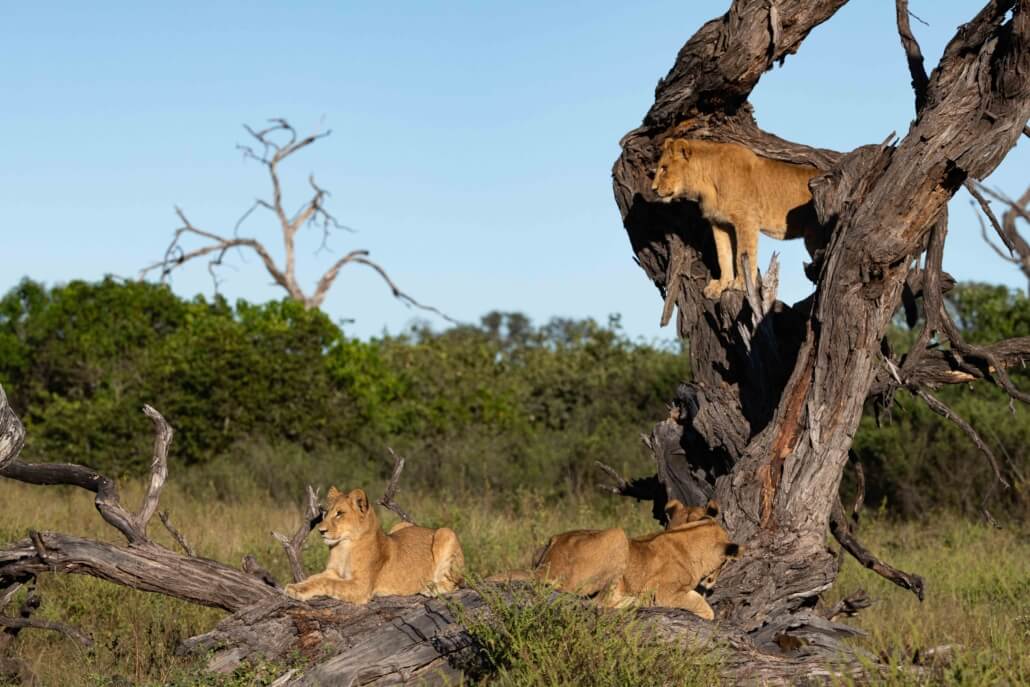
Low-light performance is one of the most important characteristics of any wildlife camera. As a photographer, I have always preferred sensors that balance resolution with excellent high-ISO performance. While higher-resolution sensors provide greater cropping potential, they often feature smaller individual photosites (microscopic, light sensitive receptors found on the sensor), making image noise more noticeable as ISO values increase.
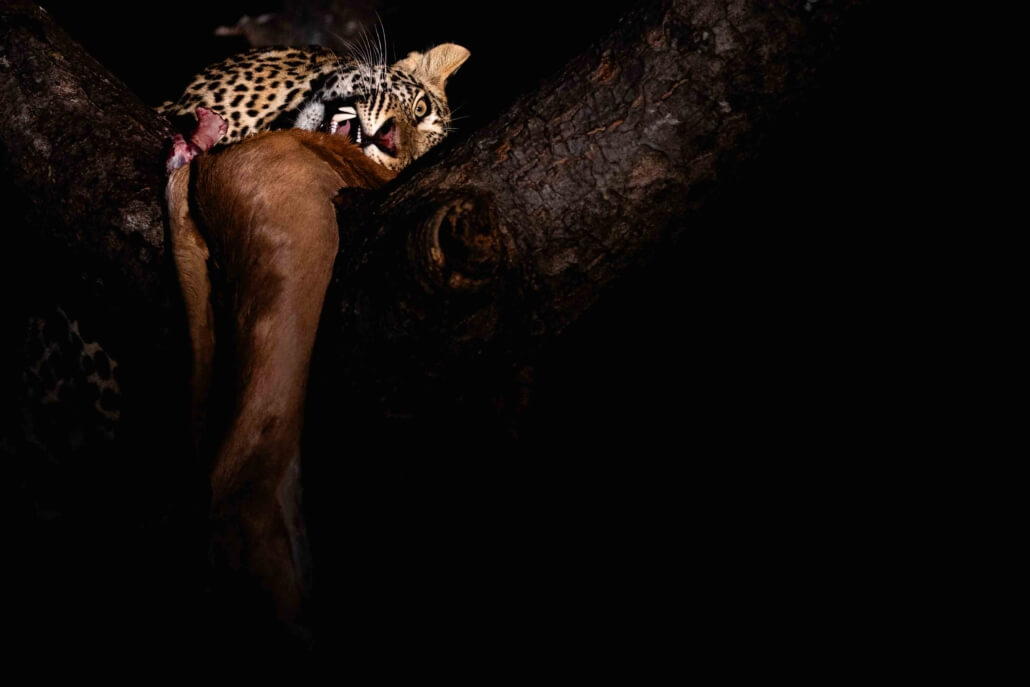
The Canon EOS C50 strikes a very comfortable balance. Its approximately 32-megapixel full-frame sensor offers more than enough resolution for commercial wildlife photography while still delivering excellent low-light performance. Throughout the safari, I regularly photographed during the blue hour before sunrise and after sunset, often in conditions where additional lighting simply wasn’t an option.
On several occasions, I comfortably pushed the ISO to around 8000 while photographing naturally lit wildlife. Using DXO PureRAW for noise reduction and image sharpening, the resulting files were remarkably clean and retained an impressive amount of detail. More importantly, they remained entirely suitable for professional publication and large-format printing.
For me, that is the true measure of a camera’s low-light capability.
Dynamic Range
Dynamic range is arguably one of the most important characteristics of any wildlife camera. Wildlife photography constantly presents scenes with extreme contrast, such as a leopard resting beneath dense shade while sunlight filters through the canopy above. Expose for the highlights and the shadows disappear. Expose for the shadows and the highlights quickly become unrecoverable.
Canon does not publish an official dynamic range figure for still photography, although the camera delivers over 15 stops of dynamic range when recording Canon Log 2 video in full-frame mode. Rather than relying on published figures, I preferred to evaluate the camera where it matters most – in the field.
Throughout the safari I deliberately photographed high-contrast scenes, knowing they would provide the greatest challenge during post-processing. The results genuinely surprised me.
When recovering highlights and opening deep shadows in Adobe Lightroom, I found very little difference between files produced by the Canon EOS C50 and those from my Canon EOS R3.
Shadow recovery remained exceptionally clean, highlight retention was impressive and the RAW files retained excellent flexibility throughout the editing process.
In practical terms, I simply couldn’t fault the camera.
RAW Flexibility
One characteristic that often receives very little attention in camera reviews is the flexibility of the RAW files themselves.
Wildlife photography rarely allows perfect exposure. Animals move unpredictably, light changes constantly and many moments last only a fraction of a second. A forgiving RAW file is therefore invaluable and the Canon EOS C50 performed exceptionally well in this regard.
Shadow detail recovered cleanly without introducing excessive noise, highlights remained surprisingly resilient and white balance adjustments could be made confidently without degrading image quality.
For photographers who prefer to maximise image quality during post-processing, this provides considerable creative freedom. Rather than worrying about absolute perfection in the field, I found myself concentrating on composition and behaviour, knowing the files would comfortably withstand substantial adjustments back at the computer.
That confidence is difficult to quantify, but incredibly valuable.
Overall Image Quality
After six days of photographing wildlife in one of Africa’s premier game reserves, my conclusion was surprisingly simple. The Canon EOS C50 produces outstanding still photographs.
Its combination of Canon’s renowned colour science, excellent dynamic range, strong low-light performance and remarkably flexible RAW files creates images that are difficult to distinguish from Canon’s flagship mirrorless cameras during normal post-processing.
For a camera designed primarily for filmmaking, that is an extraordinary achievement. In fact, by the time I returned home and began editing the images, I found myself forgetting which photographs had been taken with the C50 and which had come from my EOS R3 and that, perhaps, is the greatest compliment I can give it.
Autofocus, Burst Shooting and Real-World Wildlife Performance
Wildlife rarely gives you a second opportunity. Whether it is a leopard emerging from dense vegetation, a fish eagle launching from a dead tree or a lion charging across a river, the camera must react instantly. If it hesitates, the moment is gone forever.
One of the features I have always appreciated on my Canon EOS R3 is its autofocus system, particularly the Smart Controller integrated into the AF-ON button. Once you’ve experienced how quickly and naturally it allows you to reposition the autofocus point, it is very difficult to return to a traditional joystick.
Unfortunately, the Canon EOS C50 does not feature the Smart Controller, relying instead on a conventional joystick to move the autofocus point. While it performs perfectly well, it simply isn’t quite as quick or intuitive as Canon’s top sports and wildlife DSLR/ Mirrorless cameras.
To be completely honest, the Smart Controller alone is one of the reasons I continue to place the EOS R3 and R1 at the top of Canon’s mirrorless photography range. That said, once the autofocus point is where you want it, the Canon EOS C50 performs exceptionally well.
The Ultimate Autofocus Test
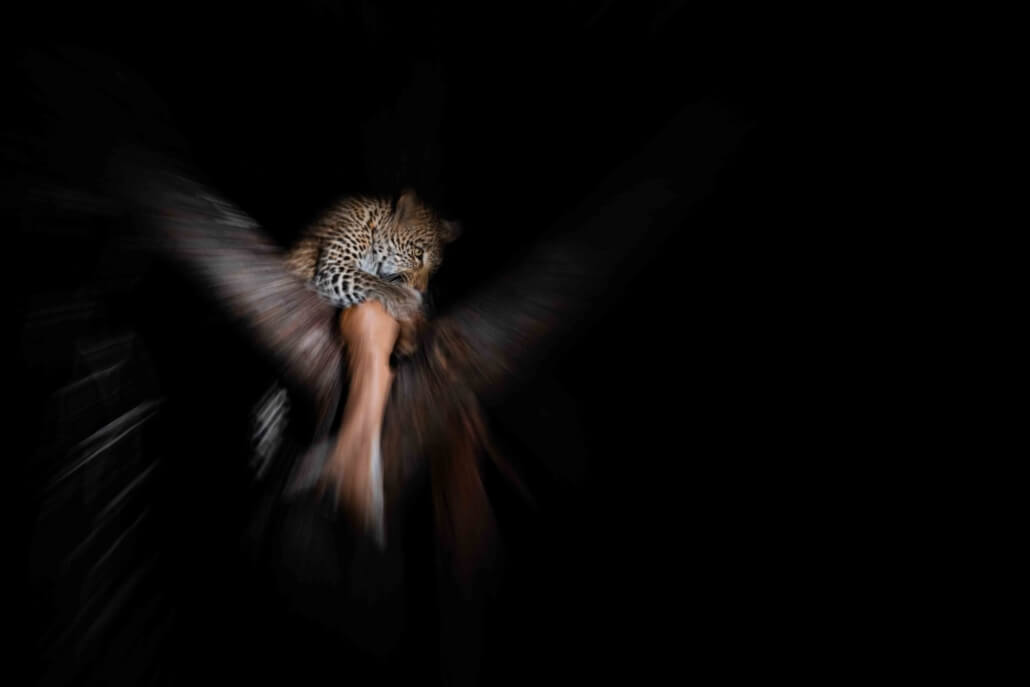
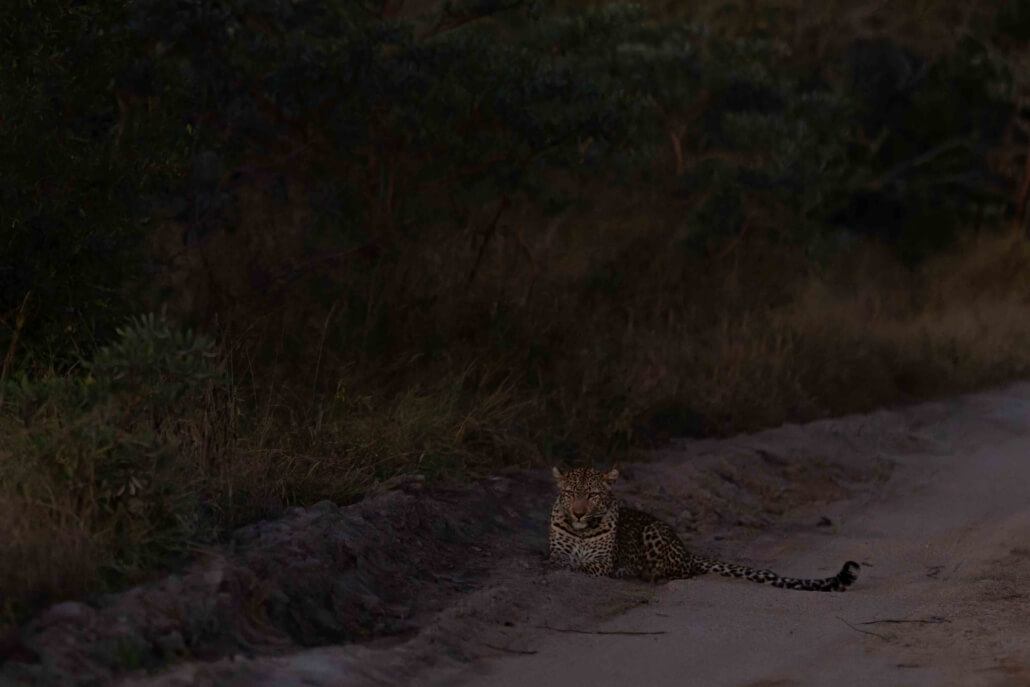
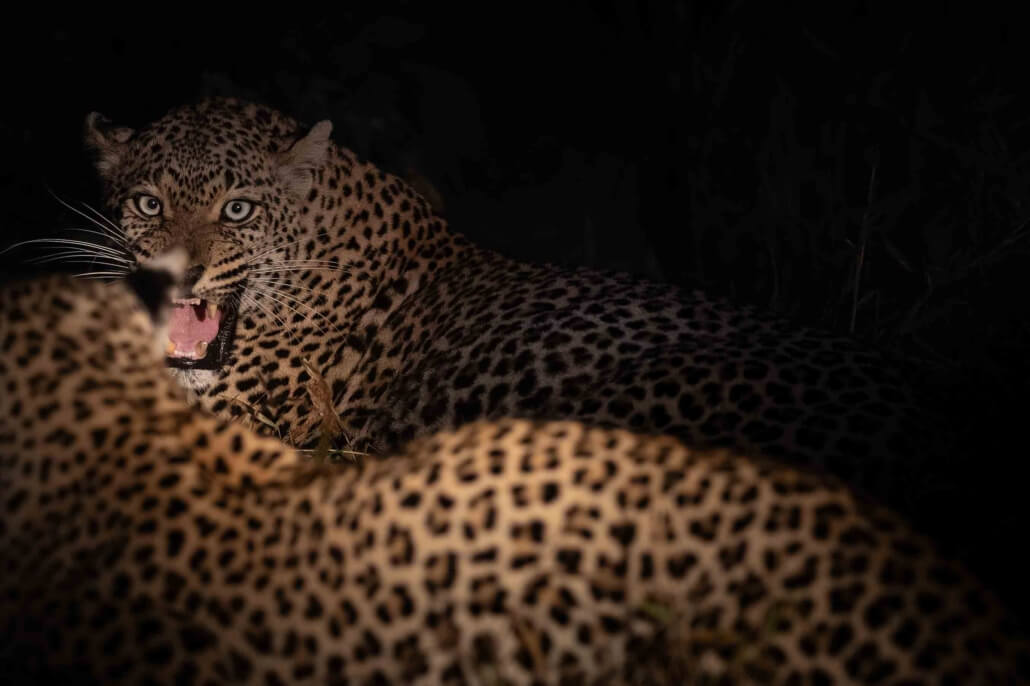
If you really want to evaluate an autofocus system, photograph a leopard before sunrise. Early one winter morning, approximately twenty minutes before sunrise, the Canon EOS C50 faced exactly that challenge – but not one leopard – rather two.
Light levels were extremely poor, and while the Eye Detection AF occasionally struggled – as expected in such difficult conditions – the camera immediately recognised both the animals and their faces.
Initially, the autofocus locked onto the leopard standing closest to us. Moments later, however, the front leopard turned away, leaving only the rear leopard looking directly towards the vehicle. Instantly, the autofocus system shifted to the second animal and locked onto its face at precisely that moment the back leopard began hissing.
Had the autofocus remained fixed on the rear of the first leopard, I would almost certainly have missed the photograph entirely. Instead, the C50 recognised the more important subject and reacted exactly as I hoped it would. Experiences like this are impossible to recreate in a studio environment, they are the moments that ultimately determine whether a camera succeeds or fails in the field.
Birds in Flight
Although this particular safari focused almost exclusively on big cats, I have since had the opportunity to test the Canon EOS C50 extensively on birds in flight while photographing in Botswana’s Okavango Delta.
Fast-moving birds are among the most demanding subjects any autofocus system will encounter. They accelerate rapidly, change direction without warning and frequently fly against complex backgrounds filled with trees, reeds and water reflections. The Canon EOS C50 handled these situations remarkably well.
Even when birds dropped lower towards the vegetation – where many autofocus systems begin to lose their subject – the camera remained confidently locked onto the bird and maintained focus throughout the sequence.
Combined with its impressive 40 frames-per-second burst rate, I consistently found myself returning home with numerous critically sharp images from which to choose. Rather than hoping for one successful frame, I was selecting the strongest composition from an entire sequence.
For wildlife photography, that is a significant advantage.
Burst Shooting
Modern mirrorless cameras have transformed wildlife photography. High frame rates have dramatically increased the chances of capturing the perfect wing position, the precise expression or that fleeting interaction between animals that lasts less than a second.
The Canon EOS C50 is capable of shooting at up to 40 frames per second, placing it comfortably alongside many of Canon’s dedicated photographic cameras. In practical terms, that level of performance is extraordinary.
Whether photographing birds taking flight, predators interacting or elephants throwing dust across a glowing sunset, the camera rarely feels as though it is limiting your creativity. My advice remains exactly the same regardless of which modern mirrorless camera you own.
If your memory cards and workflow can comfortably accommodate it, shoot wildlife at the highest frame rate available and always record in RAW. Storage may be expensive but missed opportunities are devastating.
Pre-Capture
One feature that genuinely surprised me on the Canon EOS C50 is the inclusion of Pre-Continuous Shooting. This allows the camera to continuously buffer images while the shutter button is half-pressed, automatically saving up to 20 RAW frames captured immediately before the shutter is fully depressed.
For wildlife photographers, this is an enormous advantage. No matter how experienced we become, our reaction time will never be instantaneous. Animals move first and photographers react second.
Pre-capture effectively bridges that gap perfectly.
It allows you to capture the split second before your own reflexes catch up with what is happening in front of you. Whether it is a leopard launching from a fallen tree, a kingfisher diving beneath the water’s surface or a lion suddenly roaring, those precious fractions of a second often become the most dramatic images of the entire sequence.
It is one of those features you never realise you need until you begin using it. Now that I have experienced it in the field, it is something I sincerely wish Canon had included on my EOS R3.
The Buffer
If there is one area where the Canon EOS C50 reminded me that it is not a dedicated flagship sports camera, it is the buffer. Ironically, this only became obvious because I have spent so much time shooting with the Canon EOS R3 which has never buffered.
The R3’s enormous buffer allows you to concentrate entirely on the action unfolding in front of you without giving much thought to how long you have been holding the shutter down. The C50 requires a little more discipline.
During one memorable sighting on the Chobe River, I missed a photograph of a lion crossing the water because I had unknowingly reached the camera’s buffer limit after an extended burst. It was a frustrating reminder that even modern cameras have their limitations but to be fair, however, context is important.
At 40 frames per second, virtually any camera will eventually fill its buffer if you simply keep your finger on the shutter. With a fast CFexpress Type B card installed, I found the C50’s buffer to be very respectable, comfortably allowing several seconds of continuous shooting before slowing. I just simply shouldn’t push it to the limitations like the R3.
For the overwhelming majority of wildlife situations, that is more than sufficient and the key is learning to time your bursts rather than holding the shutter continuously.
Once I adjusted my shooting rhythm, the buffer became far less noticeable.
Rolling Shutter
Because the Canon EOS C50 uses an electronic shutter for still photography, some photographers naturally express concern about rolling shutter distortion.
In my own field use, I found this to be largely insignificant. Despite photographing birds in flight, running predators and fast-moving wildlife, I encountered no situations where rolling shutter produced noticeable problems.
Unless you are photographing extremely rapid lateral movement or specialised action subjects, I suspect most wildlife photographers will rarely notice it in everyday use.
Battery Life and Active Cooling
Battery life has never been a major concern for me when photographing wildlife. A spare battery or two in the camera bag is generally enough to get through a day’s game drive. Filmmaking, however, is an entirely different story.
Recording 7K Cinema RAW Light places enormous demands on both the battery and the camera’s internal processing. When recording at the highest quality settings using the standard Canon LP-E6P battery, I found the recording time to be relatively short. Fortunately, Canon has addressed this by equipping the EOS C50 with USB-C power delivery, allowing the camera to be powered continuously from an external battery source.
For photographers, this feature may not seem particularly important. For filmmakers, it is invaluable!
During a filming shoot in the Kalahari Desert, I powered both the EOS C50 and my external monitor directly from my vehicle’s auxiliary battery system. Instead of worrying about battery changes every few minutes, I was able to concentrate entirely on filming the behaviour unfolding in front of me. This proved invaluable during one particular sighting I witnessed in January (filming, not photography).
Earlier this year I had the opportunity to compare the Canon EOS R3 and the EOS C50 while filming a cheetah hunt in temperatures reaching approximately 44°C. The difference between the two cameras was remarkable as the EOS R3 overheated in less than five minutes, forcing me to stop recording while the action was still unfolding. The EOS C50 simply carried on.
Its active internal cooling system remained almost silent throughout the entire sequence, and after two and a half hours of continuous operation the camera had still shown no indication of overheating. For anyone serious about wildlife filmmaking, this alone may justify the investment.
It is one of those features that receives very little attention on a specification sheet, yet becomes absolutely indispensable once you begin working in the harsh realities of the African bush.
One small feature that I also appreciated was the camera’s battery time estimation. As battery levels decrease, the EOS C50 provides a realistic estimate of the remaining recording time, allowing you to plan battery changes before they become a problem.
If you intend filming regularly without access to external power, I would recommend carrying at least four to five genuine Canon LP-E6P batteries to comfortably cover a full day’s filming (at 7K resolution).
User Friendliness
Over the years I have used Canon, Sony, Nikon and Olympus (now OM System) cameras extensively, and I have always found Canon to be the most intuitive when it comes to menu’s.
Canon’s menus are logically organised, colour coded and accompanied by helpful explanations that make navigating the system remarkably straightforward. Even when I encounter a setting I am unfamiliar with, I have never found myself unable to solve the problem after spending a few minutes working through the menu.
That simplicity is something I have always admired about Canon. I won’t comment too heavily on competing brands, but I have occasionally joked that some camera menus require a doctorate simply to locate the setting you’re looking for.
The Canon EOS C50 continues that simplistic Canon philosophy.
From a photography perspective, the camera is exceptionally easy to set up and operate. The transition between photography and video modes is seamless (the transition between photo and video is only about 3 seconds), while the photographic menus remain familiar to anyone who has previously used a Canon mirrorless camera.
Video, naturally, becomes more technical.
Being part of Canon’s Cinema EOS family, the C50 offers an extraordinary depth of professional video options. Recording formats, codecs, colour profiles, frame rates and shutter angle all require a reasonable understanding of filmmaking terminology.
For example, if I tell you I filmed a sequence using a 180-degree shutter angle, and that statement doesn’t immediately make sense, there will inevitably be a learning curve. Fortunately, Canon’s menu system makes that learning curve far less intimidating than many competing systems. For anyone purchasing the EOS C50 as their first professional filmmaking camera, I would strongly recommend spending time learning the camera through online tutorials before heading into the field.
Photography remains beautifully simple. Filmmaking simply requires a little more education.
The Cons
No camera is perfect and the Canon EOS C50 is no exception.
One of the first compromises photographers will notice is the absence of an electronic viewfinder – which is understandable as this is a cinema camera which does lack the EVF. Coming from the EOS R3, I initially found composing images using only the rear LCD screen slightly unfamiliar. After a few days I adapted surprisingly quickly, and the fully articulating 3-inch touchscreen proved bright, responsive and perfectly usable in most situations. For filming I do use an external monitor system, however on this particular safari, I decided to leave it at home – testing only what Canon sends in their box upon purchase.
The second compromise is the buffer. While I described earlier how respectable the buffer is in practical use, it still cannot match Canon’s flagship sports cameras during prolonged bursts.
At 40 frames per second you can fill almost any camera’s buffer if you simply hold the shutter down continuously. The C50 rewards a more disciplined shooting style, timing bursts around behavior rather than firing continuously.
For most wildlife situations this is perfectly manageable, although photographers accustomed to the virtually limitless buffer of the EOS R3 will notice the difference.
My single biggest disappointment, however, is the lack of conventional external flash compatibility. As someone who genuinely enjoys creative flash photography, this is the one aspect of the EOS C50 that gives me pause.
Every other compromise can be adapted to. The absence of an electronic viewfinder becomes normal after a few days. The buffer simply requires a different shooting rhythm. Flash, however, is another matter entirely. If your work relies heavily on external flash systems, this limitation may influence your purchasing decision.
After spending a considerable amount of time experimenting with different ideas, I believe I may have found a practical solution, yet whether that solution proves successful remains to be seen, but that is a story for Part 2.
As the old saying goes, there are many ways to skin a cat.
Overall Verdict
After six days photographing wildlife in the Sabi Sand, my opinion of the Canon EOS C50 was confirmed. What began as a cinema camera that happened to capture still photographs quickly revealed itself as one of the most capable hybrid wildlife cameras in our industry.
Its combination of excellent image quality, Canon’s renowned colour science, impressive dynamic range, remarkably flexible RAW files, outstanding autofocus and rapid 40 frames-per-second shooting makes it a genuinely capable photographic tool.
Add professional 7K Cinema RAW recording, active internal cooling, Dual Base ISO, pre-capture capabilities and the flexibility of Canon’s Cinema EOS platform, and the result is a camera that comfortably bridges two worlds.
Is it the perfect wildlife photography camera? No.
Canon’s EOS R3 and EOS R1 remain better suited to photographers whose work revolves exclusively around still imagery, but that was never the purpose of the EOS C50.
It was designed for modern visual storytellers, for people who photograph, film and document the natural world with equal passion and in that role, it succeeds remarkably well.
We live in a time where audiences increasingly consume motion rather than still imagery. Social media, documentaries and commercial productions have fundamentally changed the way wildlife stories are told.
Photography remains the foundation of my work and always will, but filmmaking has become an equally powerful tool for conservation and storytelling.
The Canon EOS C50 embraces that future.
It allows photographers to transition effortlessly into filmmaking without sacrificing the ability to capture world-class still images along the way.
For under R80,000, it offers an extraordinary balance of professional photography and cinema performance. That alone makes it one of the most compelling hybrid cameras Canon has produced.


About the Author
Armand Grobler is the founder and director of Rhulani Photo and Film, specialising in African wildlife photography, photographic safaris and mini documentary filmmaking. Having spent several years photographing and filming wildlife across Southern Africa, his field reviews are based on practical experience in some of the continent’s most demanding environments rather than controlled studio testing.

 Proudly Partnered with South Africa’s Premier Wildlife and Boutique Styled Coffee-Table Book Publishers.
 Rhulani Photo and Film
 Rhulani Photo and Film