
A Fatal Leopard Encounter
Article written by Armand Grobler, Director of Rhulani Safaris and Rhulani Photo & Film
The blog post, fatal leopard encounter is a haunting recount of events on the fateful day Armand Grobler and his guests with Rhulani Safaris experienced one of Africa’s most intense leopard sightings.
Images and Film capture by Armand Grobler.
There comes a moment in every life when one must confront the brutal truth of existence — that all things, no matter how powerful, beautiful, or wild, must one day pass from life into memory.
We carry the quiet knowledge that our time is finite, tucked away in the corners of our minds like a faded photograph – present, yet distant. We plan for tomorrow, chase dreams, chase time, forgetting that every breath we take could be our last. In the frenzied rhythm of life, we so often fail to notice the fragile poetry of the present, the true gift of today.
On the morning of June 28th, deep in the beating heart of the Sabi Sand Game Reserve, I was reminded of life’s delicate balance — and its sudden, unforgiving end. We were on our Rhulani Safaris, Sabi Sand Big Cat Photo Safari, a journey designed to find and photograph Africa’s most elusive predators in their natural habitat. What unfolded was not a simple sighting, but a story – a violent, haunting, unforgettable story. One that would etch itself into the marrow of my memory forever. As the title described, a fatal leopard encounter.
This was not just another photograph. Not just another leopard. This was the most harrowing encounters of my career. The most soul-wrenching scene I have ever witnessed in the wild. A tale written not with words, but scribed with blood on sand, claws in flesh, and the guttural roars of war echoing through the bushveld.
It was a moment where life and death embraced in their ancient dance, and I, the spectator, could do nothing but bear witness. They say you never feel more alive than when you stare death in the eyes. Until that fateful Saturday, I never truly understood what that meant.
[15 Hours Before Incident]
“If there’s one thing in nature I never want to witness, it is the death of my favorite animal – a leopard.”
These were my exact words shared with the guests as we sat around an evening boma fire whilst enjoying the African ambiance, reminiscing on the days exciting events. It was a tranquil and joyous moment, sipping away at our creamy Amarula, aromatic wine and bourbon whiskey under the blanket of a billion stars during a perfect evening.
Our Sabi Sand Big Cat Photographic Safaris are a special treat, and they always provide guests with spectacular photographic opportunities, particularly of leopard. With daily sightings of these majestic cats along with the rest of the ‘Super Seven’, the social chatter around the evening fire is almost always about the exciting sightings or of a new skill learnt or mastered during a workshop, being successfully tested on one of nature’s most elusive creatures. The evening was perfect. No one could have expected what would happen in just over 12 hours.
[Day of Fatal Leopard Encounter]
It was an uncharacteristically quiet morning. Tracks of several leopards surrounded the lodge, yet not a single cat was in sight. We drove in circles, following what we believed to be the track of the dominant male – Tortoise Pan – but something didn’t add up. The tracks came from both east and west, then veered south, only to loop back north. Confusingly, female tracks also appeared throughout the area. Then came our first stroke of luck.
As we continued looping through familiar roads, hoping to find either the male or one of the females, we spotted a fresh indentation in the sand of the local female – Tiyani’s – track clearly pressed over our own vehicle’s imprint from just 30 minutes earlier. We stopped. Listened. Investigated. The earth fell into a strange hush. The birdsong faded. Even the soft breeze stilled. An eerie atmosphere settled around us, as tangible as the unknown male’s tracks that followed hers. Who was he? And where was her cub?
Tiyani, a well-known female leopard in this region, is the mother of a small, six-month-old female cub – still unnamed. This little one has the charm of a born performer, confidently strutting past vehicles while photographers gasp and shutters click like a standing ovation. Her deep sapphire eyes mesmerize guests with a hue like the depths of the ocean. Her chirpy, curious nature is utterly infectious. It’s impossible not to fall in love the moment she steps into view.
Over our last few safaris, this cub was the undisputed star of the show, offering photographers unforgettable moments, frozen forever in memory and on camera. Guests adored her, and the thought of her now missing struck a deep chord within us.
Across the past four safaris, we had seen the cub on 80% of our drives always accompanied by her mother. Even when we didn’t spot them together, their tracks were clear: mother and daughter together, likely feeding or resting somewhere beyond the reach of the vehicles. So, when we discovered only Tiyani’s tracks that morning with no cub, and an unfamiliar male on her trail our hearts sank. Something was wrong.
Minutes felt like hours as we searched in growing despair. There was still no confirmation of the unidentified male in the area, but we silently hoped it was only Tortoise Pan, perhaps on patrol or in pursuit of a meal. Gradually, the tension began to ease, and as the drive continued, our anxiety gave way to a sense of wonder when we stumbled upon a crash of rhinos, grazing peacefully in the warmth of the morning sun.
But just as calm settled over us, everything changed.
Over the radio, our professional guide, Jordan Delvecchio, received a call that shattered the stillness. The tranquil setting was about to descend into chaos and nothing could have prepared us for what was unfolding.
“They have them – both males and Tiyani,” Jordan said, his voice strained with urgency.
Another guide, returning to camp, had inadvertently driven into the middle of a high-stakes encounter. Tiyani had been spotted fleeing from an unfamiliar male leopard – later identified as the Xitsalala male – on the Elephant Plains driveway, in close proximity to the lodge.
We rushed to the scene.
As we arrived, we saw Tiyani trotting with quiet desperation, heading toward the lodge. Her usual confidence was gone, replaced by a wide-eyed fear that chilled us. Moments later, from behind the thickets, the Xitsalala male appeared. Thick saliva dripped from his open mouth as the tension became near overwhelming. He moved with calm determination, stalking her every step. Tiyani scrambled up the branches of a nearby Jackalberry tree, trying to find sanctuary in its dense canopy as the young male kept stalking.
Leopards are fiercely territorial big cats and fatal encounters do occur. A dominant male will span multiple female ranges, and their territory is defended like a fortress. Just as we protect our homes and families, leopards protect their own. An intruding male poses little threat to the females themselves, but he is a deadly danger to their cubs. To eliminate competition and induce oestrus, an outsider will often kill any cubs he encounters and sometimes battle it out with the resident male for mating rights. Battles rarely end in serious injury or death, as leopards are solitary and any injury could hinder their ability to hunt and ultimately cost their lives. That is why the dominant male’s role is so vital – without his protection, the survival of young cubs is almost impossible.
We watched the scene unfold felt like something out of a superhero movie: the villain closing in, the heroine cornered, defeat imminent… until, just in the nick of time, the hero arrives in spectacular fashion.
Bursting through the bushes with electrifying force came Tortoise Pan. The dominant male’s sudden appearance was nothing short of cinematic – explaining, perhaps, where his daughter inherited her dramatic flair. The moment he saw the Xitsalala male, his body coiled like a tightened spring, his eyes locked in with murderous intention as his muscles tensed, and saliva oozed with irritation. In that instant, the calm protector transformed into a fearsome force of nature, ready to kill.
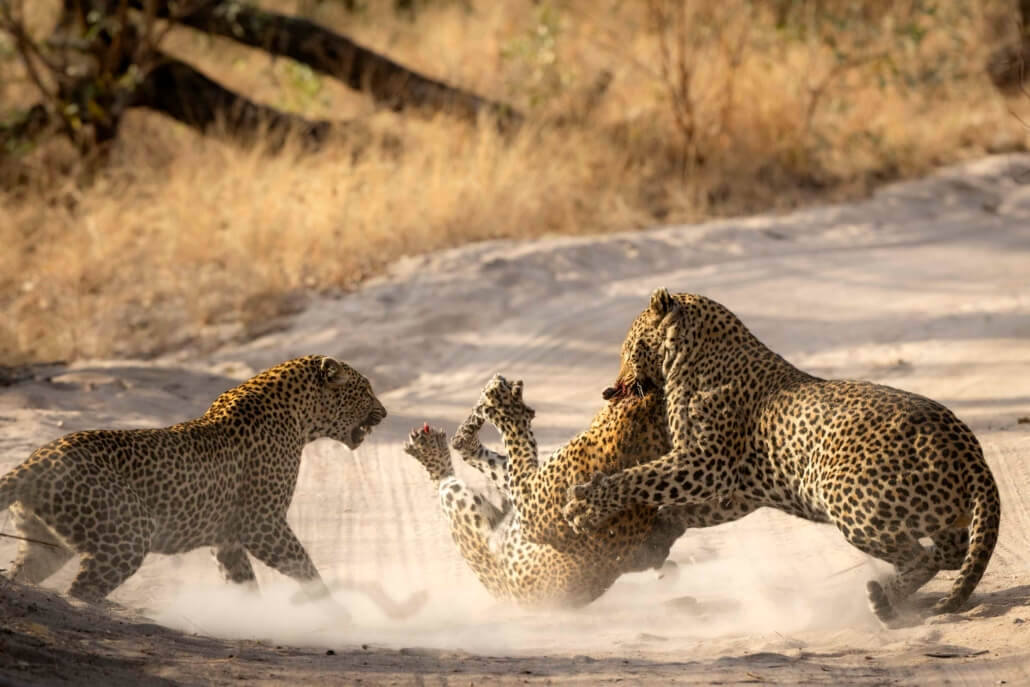
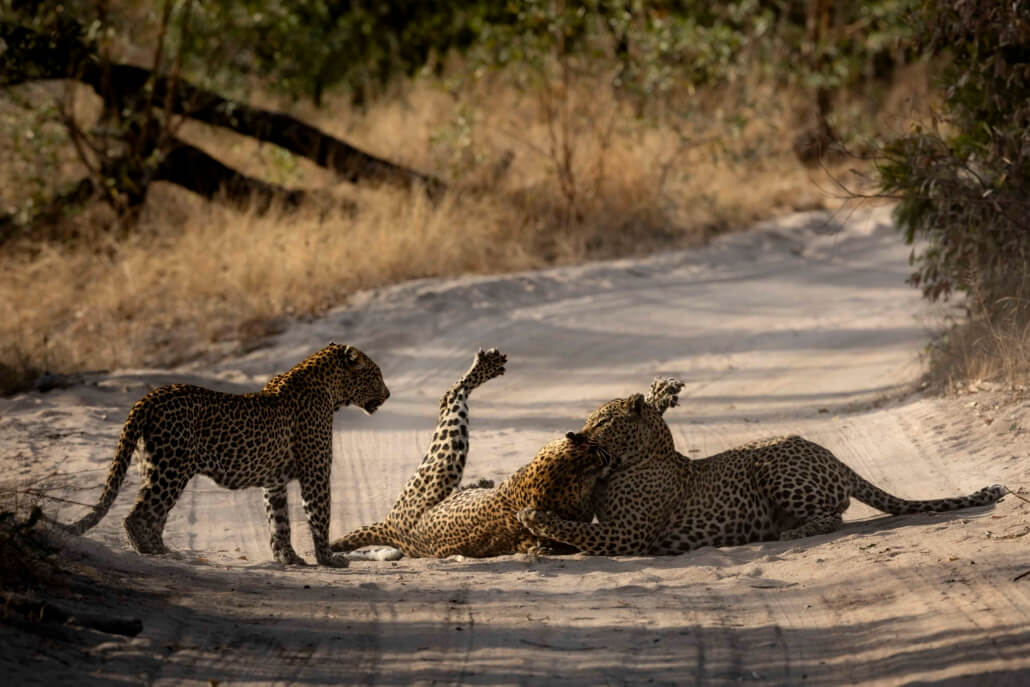

It happened so quickly that the exact moment of attack became a blur – wiped from memory as we sat in stunned silence. Jordan had positioned the vehicle perfectly, maintaining a safe distance while staying well out of the brutal battle that unfolded before us.
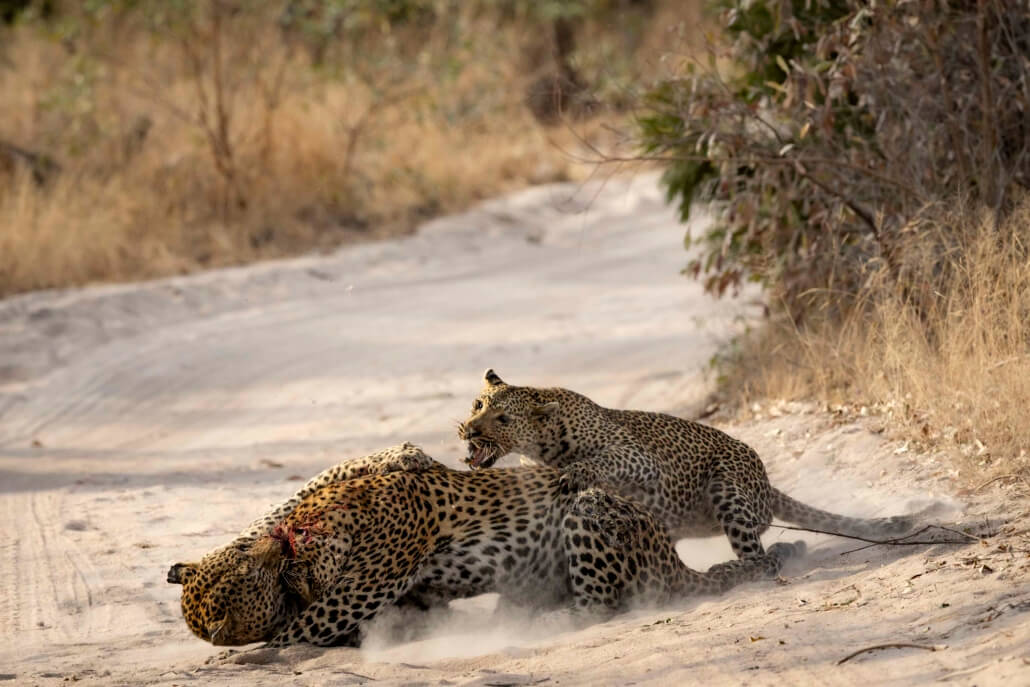
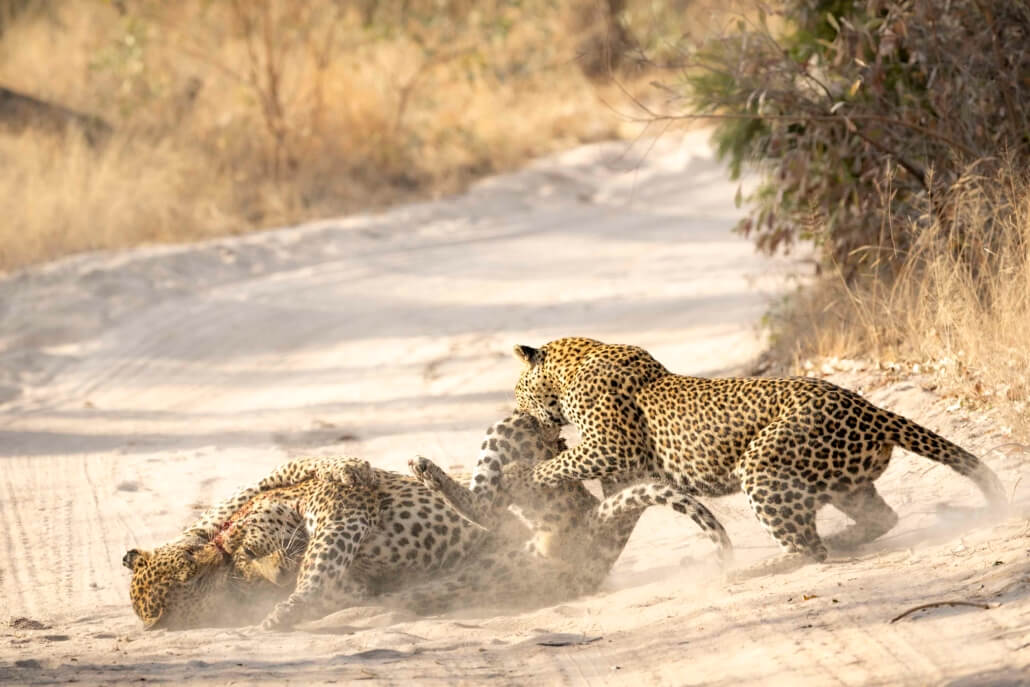
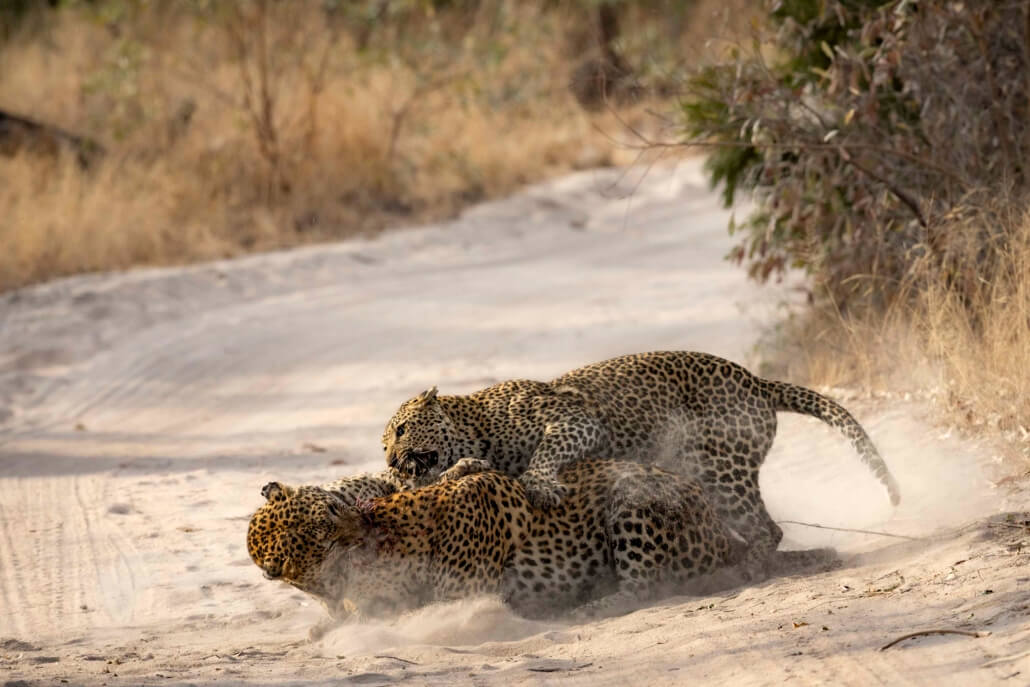
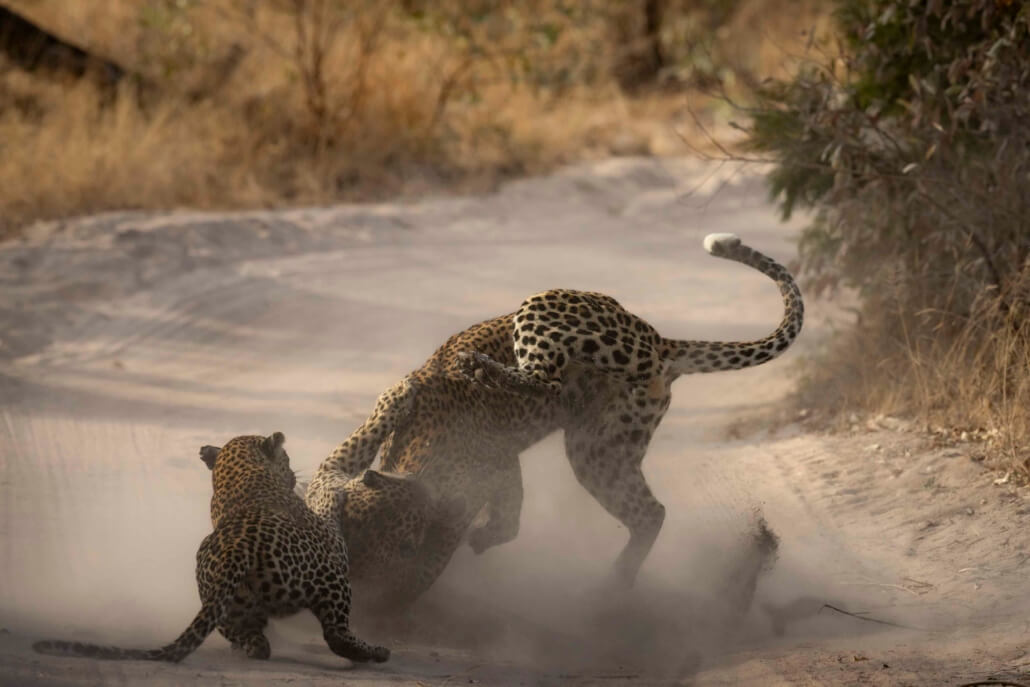
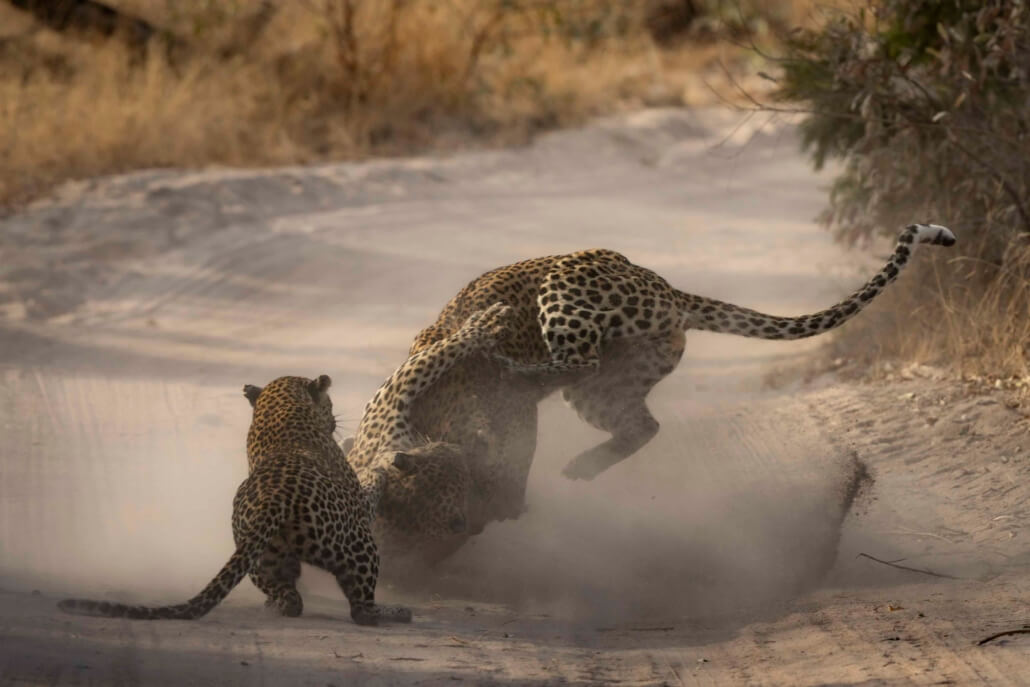
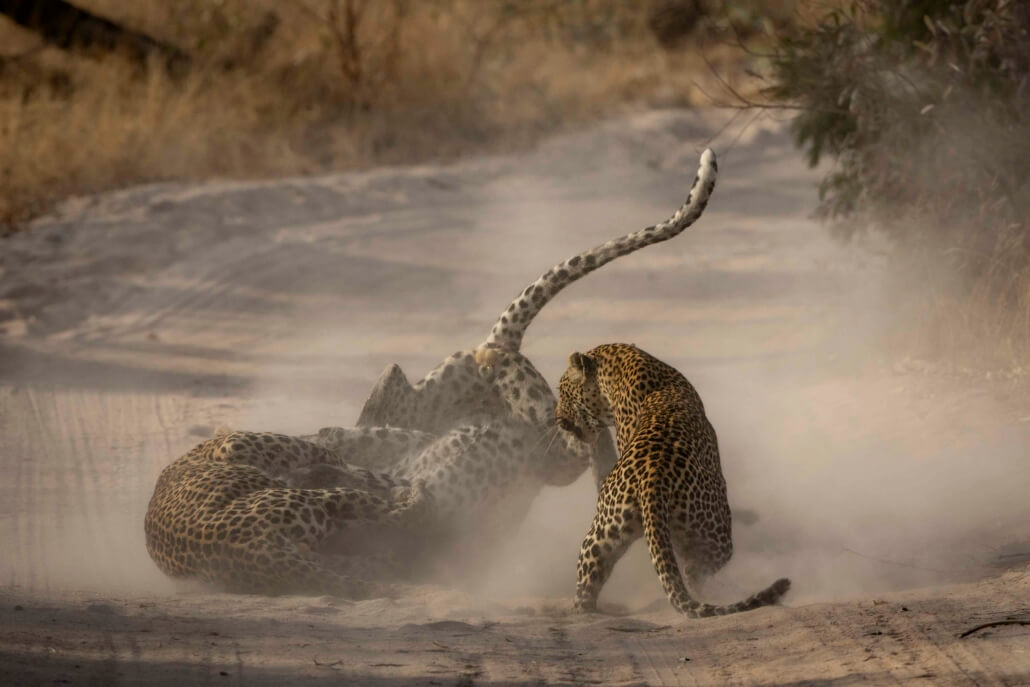
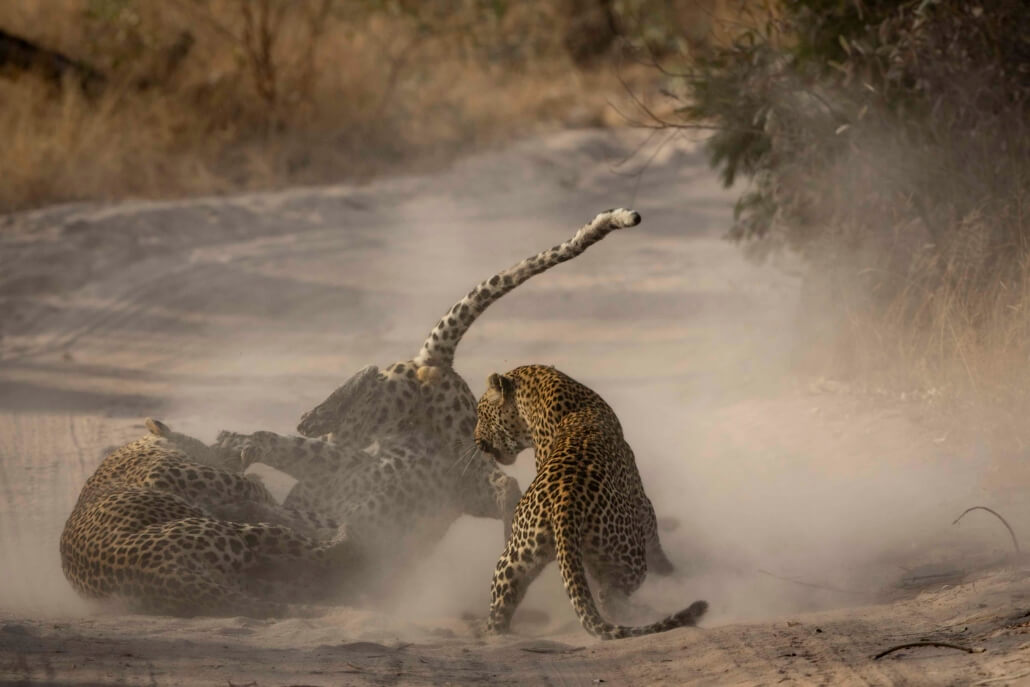
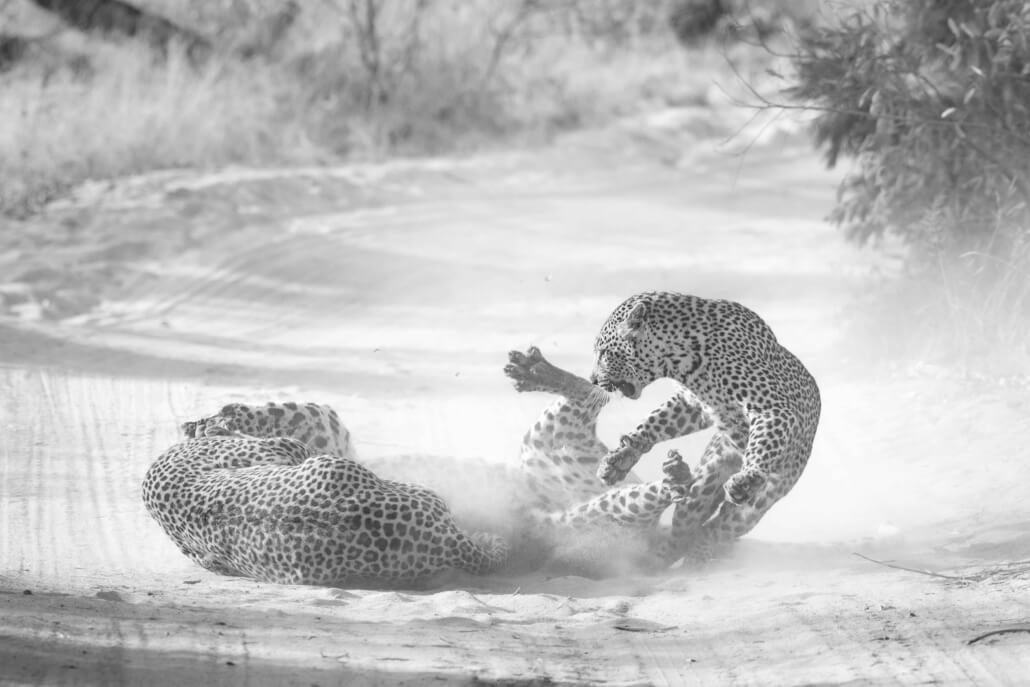
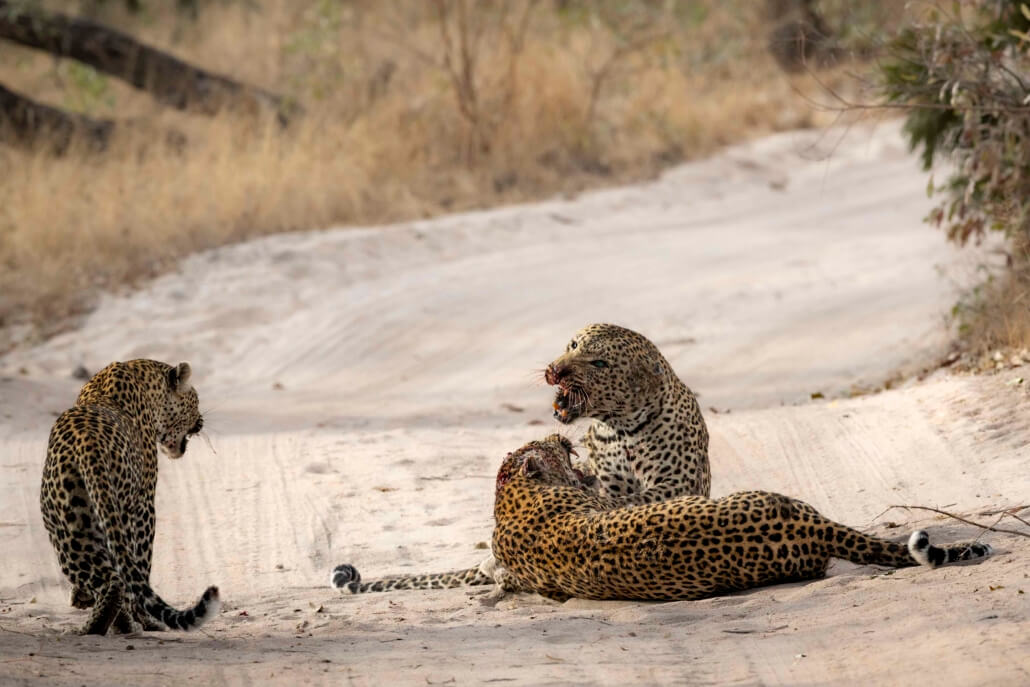
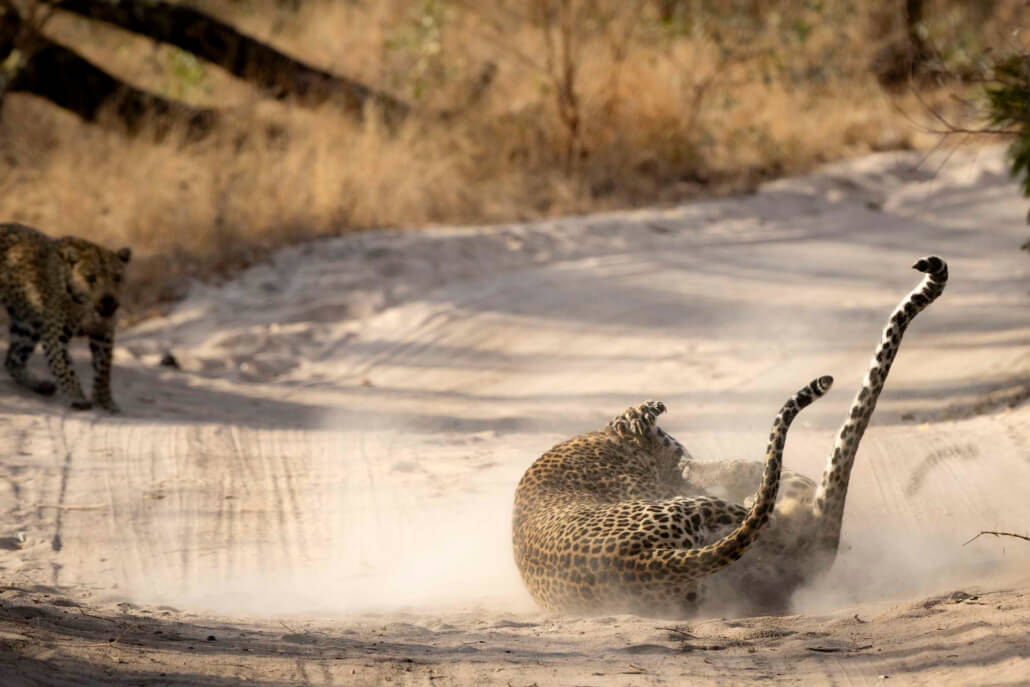
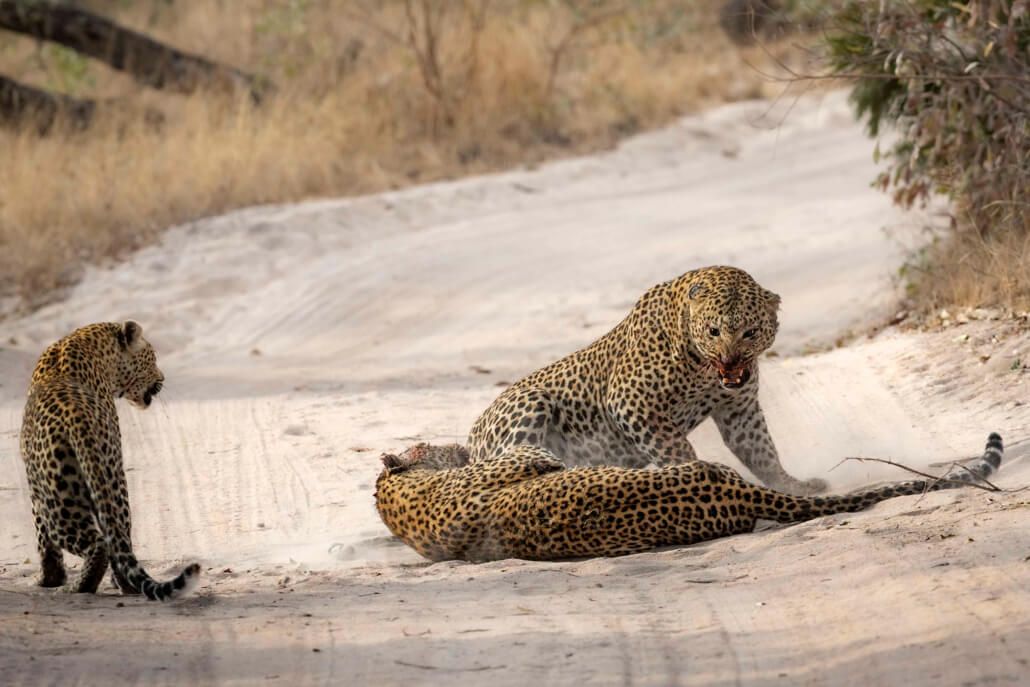
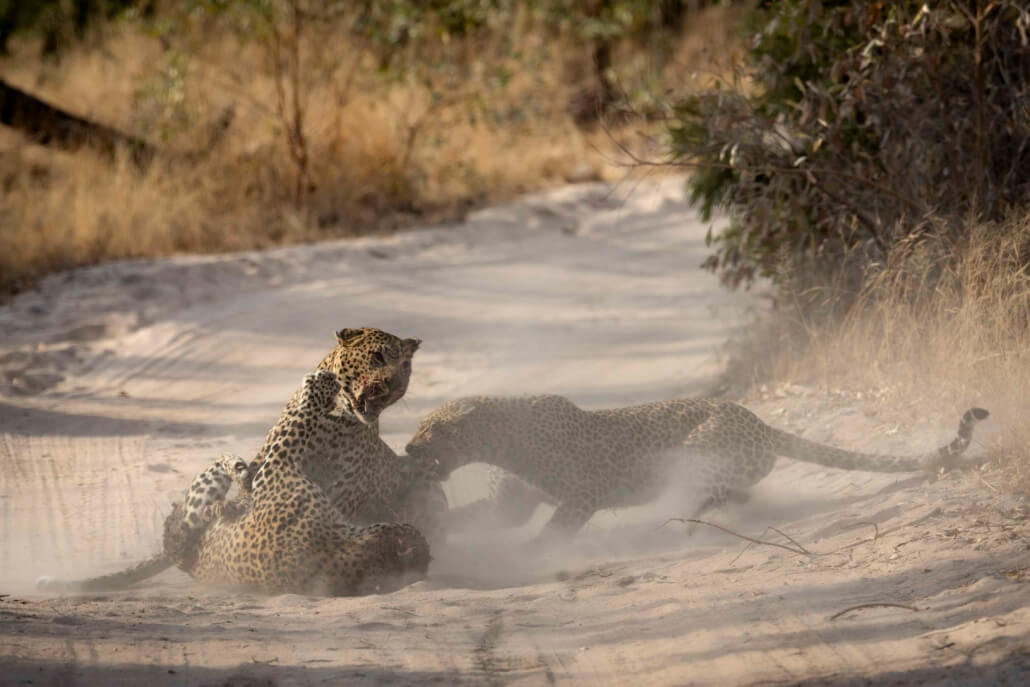
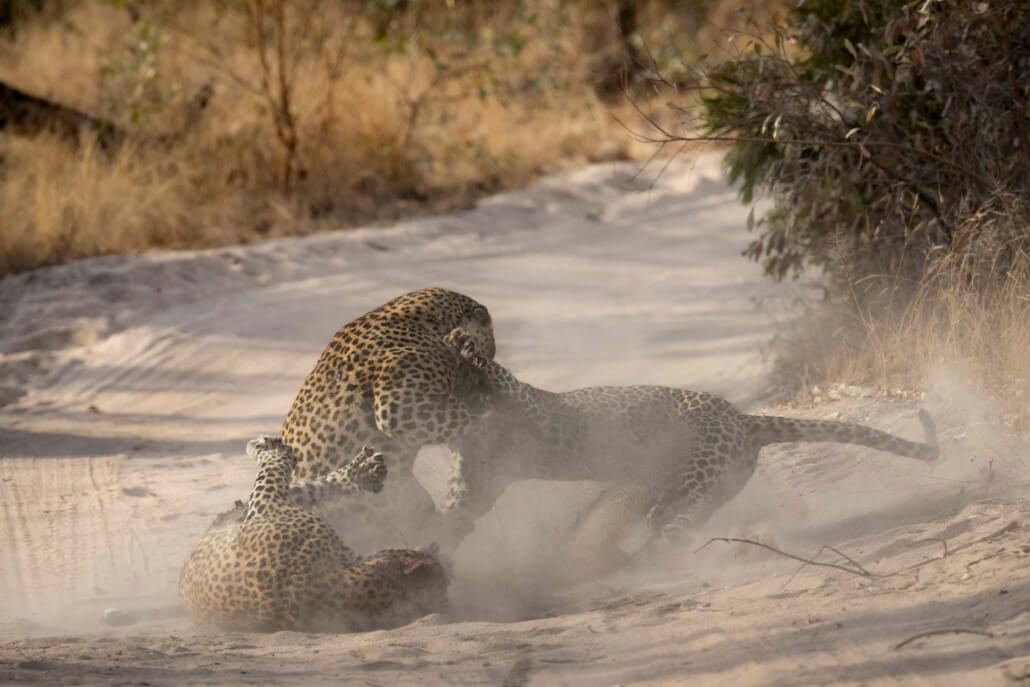
Tortoise Pan struck with blinding speed, locking his jaws behind Xitsalala’s head in a deathly vice grip, sinking his canines deep into the younger leopard’s skull, severing vital nerves. This was evident in Xitsalala’s reaction with claws unsheathed, his body convulsing uncontrollably in violent death throes. Despite his agony, he fought back, but unbelievably, the female leopard – still wary of the young male – suddenly descended from the tree and joined the fray. She lunged at Xitsalala’s underside, biting and pulling with determination, while the larger Tortoise Pan pinned him down mercilessly. Chunks of flesh, tufts of fur, and splashes of saliva erupted like a volcano, fragments flying through the air in every direction.
We couldn’t believe what we were witnessing. Never before, to our knowledge, had such behaviour been documented – two leopards ganging up on another in this way. The female, despite her caution toward the young male, kept returning to bite at him relentlessly, pausing only briefly to catch her breath. The deafening roars of battle silenced the entire bushveld. While the roar of a lion is known to vibrate through your chest, this was something else entirely, on a complete other level. The snarling cries and furious roars of the leopards pierced us to our very core, leaving a permanent mark on our aching souls. Whether it was the adrenaline coursing through my veins, the bone-shaking roars, or both – it was nearly impossible to hold the camera steady enough to continue shooting.
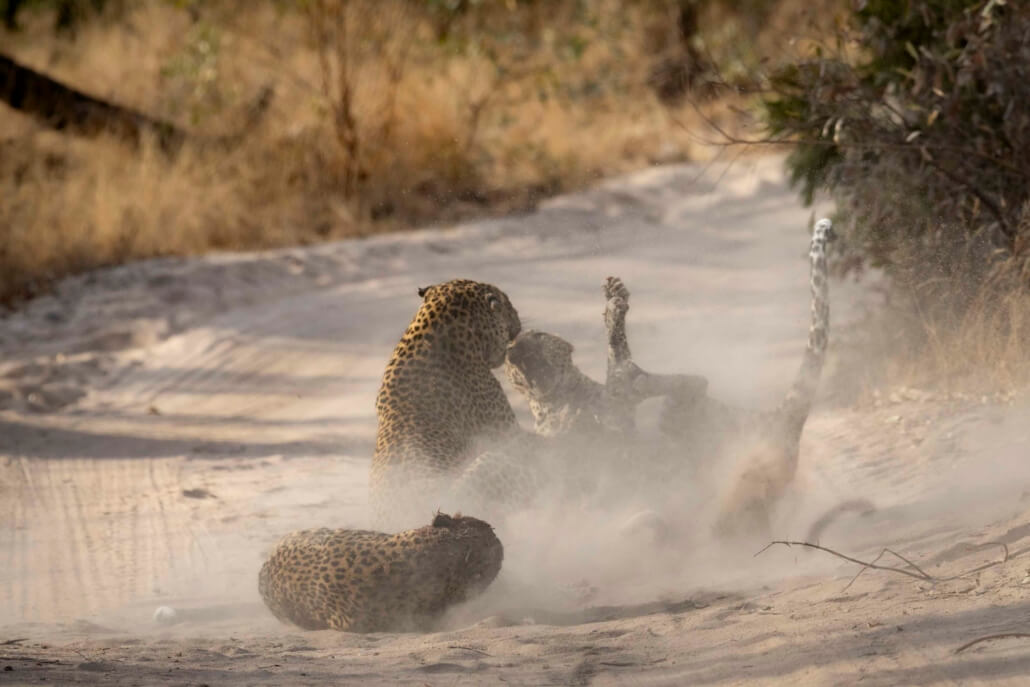
Like the choking flames of Hades, dust swirled around the combatants, kicked up by the chaos of their clash, engulfing all three in a blinding veil of confusion. In the frenzy, the female leopard accidentally bit Tortoise Pan on the hind leg, causing him to leap away in pain. At one point, both leopards even turned on each other, leaving the wounded Xitsalala writhing alone, only to return once they realized their mistake. But the brief reprieve came too late. His injuries were already fatal. He lay prostrate, awaiting the final blow with a silent, tragic dignity.
It came swiftly. After recovering from the mistaken bite by Tiyani, Tortoise Pan launched a final, devastating attack. He clamped his fangs deep into Xitsalala’s chest, tearing chunks from his weakening body and shaking him like a ragdoll. In the photographs, the moment is captured vividly – Xitsalala’s head thrown back in a grisly spasm from the impact.
And then… silence.
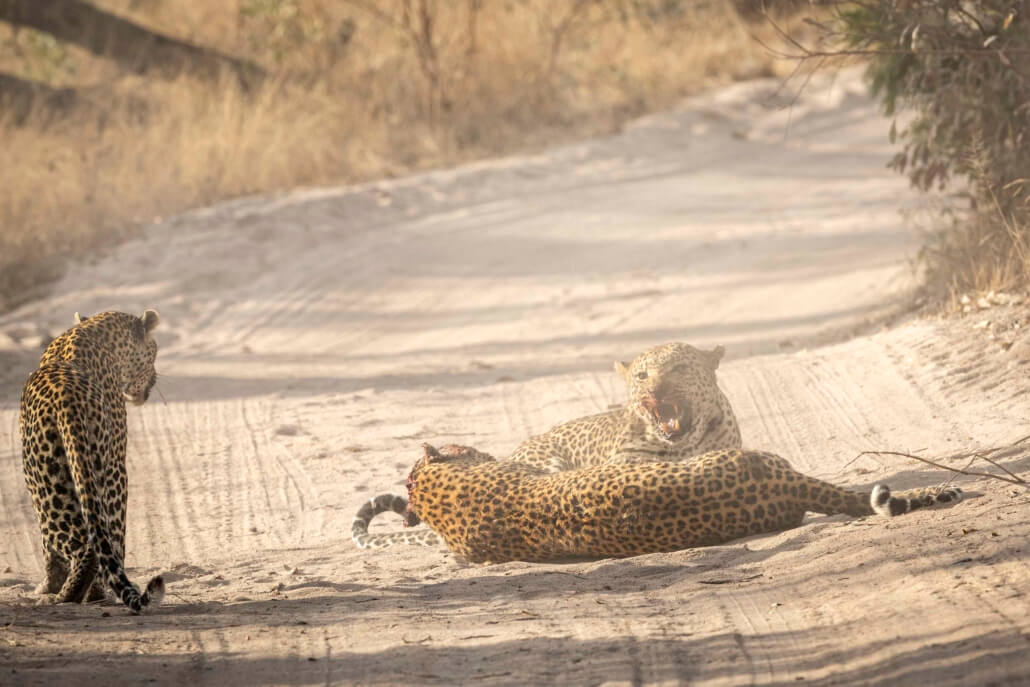
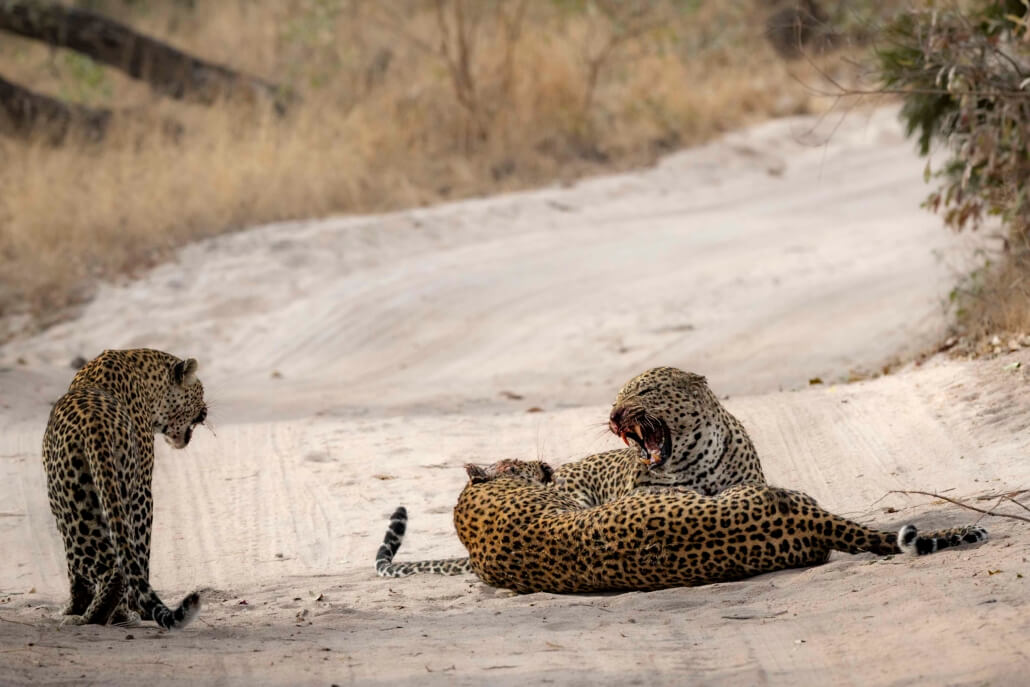
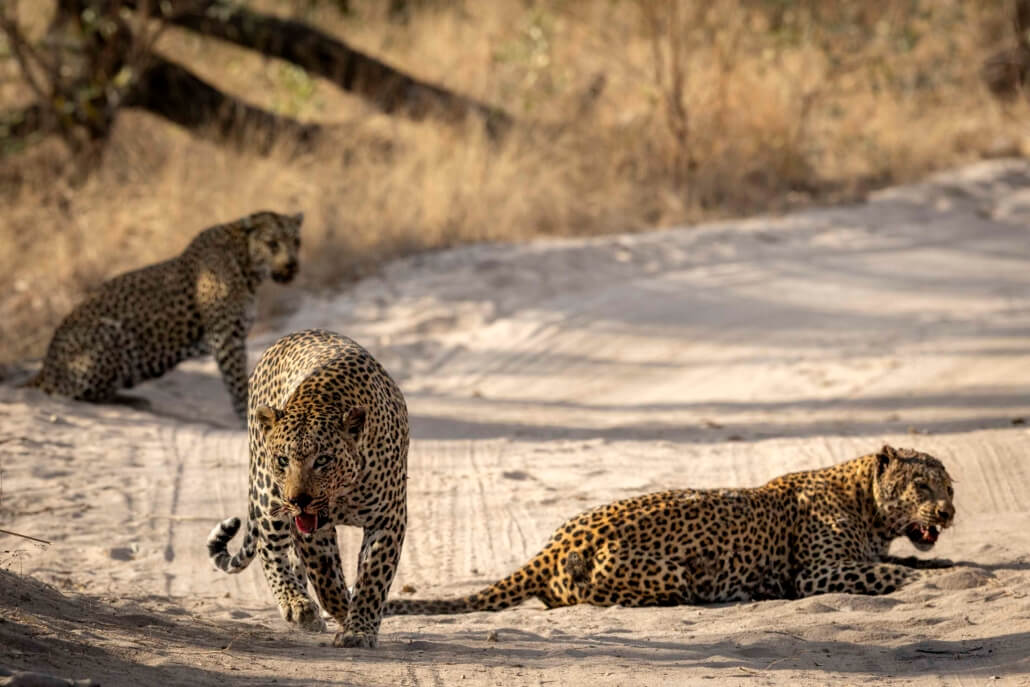
All three leopards, drained of every ounce of energy, lay beside each other like battered warriors after a long, merciless war. The Xitsalala male lay with his head flat on the sand, taking painfully slow breaths. It was enough, we could take no more and had to head back to the lodge for an intensive debrief.
We found out later that soon after our departure Tiyani left the scene, and Xitsalala crawled weakly to lay under a nearby bush where he exhaled his final breath. Almost sadistically the Tortoise Pan male rested close beside his carcass, watching ominously for any sign of survival. Eventually he too moved on as the body of Xitsalala lay unmoving, the tragic memory of the event marked under the shade of the Jackalberry tree. Minutes later the new guest arrivals drove past the murder scene, completely unaware of the battle that transpired only a short while ago.
As the sun melted into the distant horizon and we savoured the last sips of our creamy Amarula, a heavy silence settled over us. The day’s adrenaline still pulsed in our veins as we replayed the scene over and over, as the sighting dominated all our conversation. Then a single, haunting question cut through the calm – but where’s the cub?

[2 Days Later]
We backtracked through our memories, trying to recall the last time we’d seen the cub. No matter how many times we ran it over in our minds, the answer remained the same – we hadn’t seen a single sign of her in four days. Not a track, not a sound. Nothing. And we weren’t alone. None of the guides had seen any indication of her presence either. Slowly, an ominous atmosphere settled over the lodge and among the guides out on drive. Something didn’t add up…
How long had Xitsalala been in the area? Could he have killed the cub before turning on her mother? It was even suggested that Tiyani’s aggressive reaction toward the male was because he had killed her cub. The sense of despair was overwhelming. If you read my previous article – the one where Tiyani boldly confronted a male lion to defend her cub – you’d recognise the eerie similarities. Not again… Last time was a miracle. But can a miracle happen twice?
It may go against the principles of nature to develop affection or emotional attachment to a wild animal, yet sometimes, it’s simply impossible not to. Those big blue eyes filled with innocence, that chirpy personality capable of brightening even the darkest day, and her comical, bouncing strut – all the charm and elegance of a wild cub wrapped into one unforgettable spirit. She doesn’t understand evil. She only knows how to live with joy. How could this innocent little creature be gone?
As the days passed, despair deepened. Eventually, only our guide Jordan kept the hope alive.
[Final Day]
We had searched tirelessly for days with no sign of the missing cub. Theories were shared, none of them hopeful. Even Jordan, despite his ongoing optimism and final droplets of positivity, was beginning to accept the harsh reality that she might never be seen again. A few days had passed since the violent encounter, and the Tortoise Pan male lay curled up, licking his wounds, clearly still in pain. His once-dominant presence now reduced to a sulking mass of torn fur, his pride and power temporarily eclipsed by deep vulnerability.
That morning, we embarked on what’s known in the industry as a ‘nature appreciation drive’ – a peaceful outing when the action slows and guests soak in the quiet beauty of the bush. We paused beneath the shade of a marula tree for Amarula coffees and freshly baked cookies, unaware that fate was about to intervene. A faint dust cloud approached, but no one gave it much thought until the wide-eyed, ecstatic face of fellow Elephant Plains guide Jordan Nell (nicknamed Nell) came into view. He was waving frantically and shouting, “Come quickly! We’ve got Tiyani!”
There are moments in life you simply never forget. Our guide, Jordan Delvecchio, was mid-pour with the Amarula coffee when the news hit. His expression as he looked at me, half confused, half stunned, will be forever etched in my memory. Out flew the coffee as laughter erupted; the mood flipped in an instant. “Let’s go!”
We rushed to where Nell had reportedly spotted Tortoise Pan, but he pointed us in another direction. “Tiyani’s over there,” he said. So we turned toward her. Mother was present. Father was nearby. But… where was the daughter?
With Nell’s help, we quickly found Tiyani. Having spent hours tracking her over the past few drives, Jordan decided to stay with her for a while so we followed as she moved gracefully through thick scrub. Then suddenly, like a voice from the heavens, one guest softly said, almost disbelievingly and quite simply:
“There’s the cub.”
Out she came, bounding joyfully from the bushes with her usual strut, racing toward the sound of mother’s call. A wave of emotion swept over us as the shackles of tension shattered. Relief was overwhelming. We sat in awe as mother and cub reunited, playing together just metres from our vehicle. Another miracle. Another unforgettable ending to a truly remarkable safari.
Once again, our guests were blessed beyond measure, witnesses to a story of heartbreak and hope. This seems to be the running theme of 2025 for Rhulani Safaris. I’ve even considered renaming the experience: Sabi Sand Big Miracle Safaris!
[Why did it Happen?]
On the Ethics of Non-Interference.
Much has been said about the seemingly brutal nature of this incident. Accusations like “Why didn’t you do anything to stop it?” and “You’re just in this for the likes and views” have flooded the internet. Both I and those who shared the sighting have received significant criticism for not intervening to save the Xitsalala male leopard.
There are several reasons why we didn’t – and couldn’t – step in, but let me begin with the most fundamental: had anyone interfered in this sighting, whether by chasing off Tortoise Pan with a vehicle, a stick, or anything else, they would have faced immediate dismissal and possibly a permanent ban from the Sabi Sand Private Nature Reserve. As custodians of nature and conservationists, we are bound by a strict code of ethics: we are observers of nature’s beauty and brutality. No matter how heart-wrenching a moment may be, we do not interfere.
There are rare exceptions where qualified park or game rangers may intervene, typically when an animal is injured due to human interference, like a snare or vehicle collision. But for guides and guests on safari, involvement in natural predation is strictly prohibited.
If you need a human analogy, think of a car accident scene. If an untrained bystander attempts to assist a critically injured person without proper first aid knowledge, they may worsen the injuries or even be held responsible for the person’s death. In nature, our lack of understanding of the full picture can do far more harm than good.
Beyond the rules and legalities, nature operates on one principle alone: survival of the fittest. Only the strongest, smartest, most adaptable, and cunning individuals survive. The weak make way for those better equipped to carry the species forward. If we interfere today, we may unknowingly compromise the genetic integrity of future generations. By saving an individual, we may risk the health of an entire bloodline or even a species. The ripple effect of such actions can be devastating.
I understand how difficult this is to accept. I’ve been there. At a previous reserve, I had the rare and profound privilege of raising a litter of three leopard cubs. I watched them grow into stunning adults, yet no matter how large they became, I always saw them as the tiny cubs I had known. I broke many rules – possibly even common sense – by continuing to visit them until they were well over two years old and fully capable of killing me. My love for them knew no boundaries. There was no cost I wasn’t willing to pay to be with them.
So, perhaps more than most, I struggled deeply with this sighting. As I watched it unfold, I couldn’t help but picture the faces of the cubs I had once raised.
There’s also a final, often overlooked truth: had the Xitsalala male survived that day, the young cub would have been in grave danger. He would likely have killed the cub and abandoned its carcass leaving a sinister message to Tiyani, a brutal reminder of her failure as a mother.

[In the End]
Big Cat Photographic Safaris are always eventful, joyful, and educational. Sometimes, they are even terrifying and heartbreaking. What my guests and I witnessed on the 28th of June was nothing short of a once-in-a-lifetime sighting, an encounter so rare and raw that we may never experience anything like it again. It was intense, gut-wrenching, and haunting, yet above all, it was a perfect display of nature: unsophisticated, unbiased, and unprejudiced.
We witnessed the death of a beautiful animal. But as so often holds true in life, from the ashes of death rises new life. And now, we turn our hearts toward what lies ahead – more time with Tiyani and her precious cub. We hold hope in watching her grow into a strong and beautiful adult, just like her mother, and we dream of the day she too might raise cubs of her own, continuing the legacy.
Though Xitsalala has left this world, his story lives on, etched into the images, the memories, and the hearts of those who followed his journey. We remember him not just as the young male he became, but as the bright-eyed cub full of promise and innocence. His spirit will live on in the quiet rustle of the grass, in the shadows of the trees he once climbed, and in the silent pause of those who loved him.
Because love for a wild animal doesn’t end with their passing, it echoes, just as their presence once did, across the soul of the wild.
Article by Armand Grobler
Director of Rhulani Safaris (Rhulani Photo & Film)

 Proudly Partnered with South Africa’s Premier Wildlife and Boutique Styled Coffee-Table Book Publishers.
 Rhulani Photo and Film